Antisemitism
In Search of Lost TimeAntisemitism in the novel is a principle of social classification that turns Jewish identity into an alleged explanation for political conduct, cultural difference, and even ordinary choices of residence. Its force lies not only in open exclusion but in its ability to make exclusion sound like patriotism, social propriety, or learned observation. Through the Guermantes’ response to Swann’s Dreyfusism and Charlus’s treatment of Bloch, the narrative shows prejudice moving between drawing-room etiquette, political argument, and the performance of intellectual wit.
Social Boundaries and Conditional Acceptance
The Prince de Guermantes’s antisemitism determines whom he will admit to his house even when social distinction might otherwise recommend them. His wife’s salon includes prominent guests whom the Princess would not receive, among them Baron Hirsch and celebrated Bonapartists and Republicans; her husband’s royalism excludes political figures he opposes, while his antisemitism, described as a matter of principle, is not overcome by social prestige. Swann is a conspicuous exception only because the Prince sustains a convenient family legend: that Swann’s father descended from the Duc de Berry. On that false hypothesis, Swann can be imagined as a Catholic Bourbon descendant and therefore, in the Prince’s account, a Gentile. His acceptance is thus less a rejection of the prejudice than a special exemption devised to preserve it.
At a gathering in the Prince’s rooms, the Duchesse de Guermantes is herself uneasy about the prospect of being seen in conversation with Swann amid antisemitic company. She prefers their friendship to remain private, and learns that the Prince has already refused to receive him after their altercation. The episode separates private affection from public recognition: the Duchess can cherish Swann while the household’s social and political climate makes acknowledging him openly a risk. Elsewhere, her sharp appraisal of a party’s guests shows how elite belonging is policed by gestures, invitations, and small acts of greeting. The wider social order that sustains antisemitism is made visible in these ordinary decisions about who is admitted, avoided, or treated as an embarrassment.
Swann, Dreyfusism, and Political Loyalty
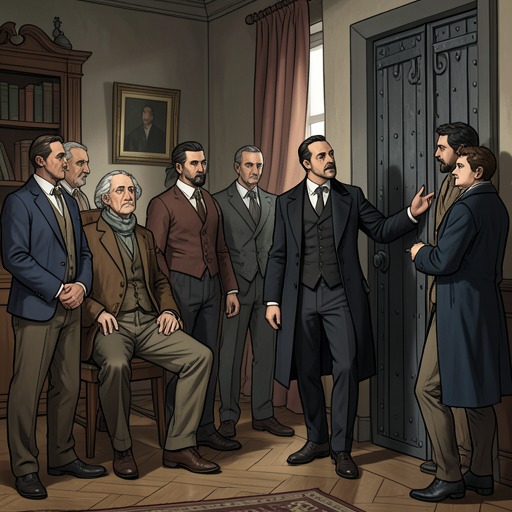
The Duke’s anger at Swann’s support for Dreyfus presents political disagreement as a breach of personal obligation. He recalls that Swann was introduced into society by the Guermantes and the Duc de Chartres, and lists the qualities that had made him seem safely assimilated: a cultivated collector, a member of the Jockey Club, a family man, and a connoisseur who knew where to find good wine. The Duke treats Swann’s Dreyfusism as ingratitude toward the society that adopted him. In his view, Swann should have disavowed Jews and the accused in return for the friendship shown to him.
That demand becomes more explicit when the Duke distinguishes a foreign Dreyfusard, whose opinion he says is immaterial to him, from a French Jew. He had believed that a Jew could be French and honourable, and cites Swann as proof—until Swann’s support for Dreyfus unsettles that belief. The contradiction is revealing: Jewish belonging appears acceptable only while the Jewish individual behaves in ways that confirm the majority’s expectations. Once Swann takes a position that conflicts with the Duke’s politics, the Duke recasts his former trust as a mistake and his political judgment as evidence against Jews collectively.
The Duke also converts Swann’s stand into a claim of collective Jewish solidarity. Because Swann supports an accused man he scarcely knew, the Duke concludes that Jews must secretly unite behind anyone of their own race. He presents this supposed solidarity as a public menace and invokes the proverb “Ab uno disce omnes,” treating one person’s action as proof about an entire group. The novel places this inference within the growing social force of the anti-Dreyfusard reaction. What had first appeared as a political dispute has had time to harden into a social antagonism bound up with militarism and patriotism; Swann’s case is judged not simply by what he believes but by the identity the Duke assigns to him.
Prejudice as a Performance of Learning
Charlus’s remarks about Bloch extend antisemitism into a display of historical and etymological knowledge. After learning that Bloch lives at La Commanderie, Charlus calls the address an affront because he associates such names with the Knights of Malta and other Christian military orders. He then asks for Bloch’s Paris address. When told that Bloch’s father has an office in the Rue des Blancs-Manteaux, Charlus dwells on the street’s connection with religious orders and presents the family’s location as a further act of profanation.
The performance is elaborate: Charlus links the street’s name to the mendicant friars established there by Saint Louis, contrasts it with a nearby Jewish quarter, and imagines that Bloch should live among people of his own religion. He claims to approach the subject only aesthetically, praising Spinoza, Rembrandt, and the beauty he associates with the synagogue, yet immediately argues that a ghetto is more beautiful when it is homogeneous and complete. The professed admiration does not undo the exclusion; it gives it a cultivated vocabulary. His assertion that Bloch chose the address for convenience and supposed commercial motives turns an ordinary residence into confirmation of a racial stereotype.
Charlus’s speech also reveals how prejudice can hide its purpose beneath apparent abstraction. He tells the narrator that his interest is artistic rather than political, but the narrator recognizes that his questions about Bloch’s home have another aim: to discover the address. His performance of indifference and his antiquarian digressions coexist with an active curiosity about Bloch’s whereabouts. When Morel, who has noticed Bloch’s effect on Charlus, thanks the narrator for having sent him away and attributes Bloch’s wish to remain to jealousy, his own antisemitic slur echoes the broader social reflex of reducing a person’s motives to group identity. Charlus, meanwhile, asks whether Bloch can be brought back, making the gap between his contemptuous public talk and his interest in the man unmistakable.
The Invention of a Racial Type
The narrator’s reflection on Charlus’s sexual identity provides a broader account of how societies manufacture stigmatized groups. It describes a persecuted population driven into concealment, compelled to deny the very life it leads, and excluded from ordinary friendship by the expectation that disclosure will bring disgust. The analogy with Jews is not a claim that the two histories are identical; it identifies a shared mechanism by which social opprobrium shapes the conduct and self-understanding of those it targets.
In this account, persecution helps produce the appearance of a distinct race. Those subject to exclusion may seek one another’s company for support, even while denying membership in the group because its name has become an insult. They may also expose others who conceal their identity, partly to defend themselves by making the group visible elsewhere. The narrator compares this process to the search for historical examples of sexual inversion and to Jewish claims on figures such as Jesus, while stressing that stigma and punishment have helped make the categories appear fixed and hereditary. The passage describes a secret network sustained by shared tastes, needs, dangers, knowledge, and vocabulary, while also emphasizing the isolation and mistrust that persecution imposes.
The comparison is ethically and rhetorically unsettled: it exposes the violence of racializing a minority, yet its language also relies on sweeping claims about groups and their histories. That tension matters to the novel’s treatment of antisemitism. Prejudice is shown as a structure that manufactures collective identities and then cites those identities as proof of the suspicions that produced them. The same circular reasoning appears in the Duke’s inference from Swann and in Charlus’s reading of Bloch’s address: the person is first interpreted through a stereotype, and the interpretation is then offered as evidence that the stereotype was true.
Political Reversal and the Persistence of Bias
The Duke’s political position later changes after he encounters three women at a spa who support Dreyfus. He had returned from the cure a committed anti-Dreyfusard, but the women challenge his arguments, laugh at what he presents as damning evidence, and insist that a man cannot be imprisoned without proof. Their influence, and his desire to please them, gradually leads him to adopt their view; on returning to Paris he becomes a fervent Dreyfusard. The episode presents political conviction as vulnerable to personal contact and social influence rather than as an unalterable expression of character.
That reversal does not itself establish that the Duke has abandoned antisemitism. Earlier, he had treated Swann’s Dreyfusism as proof of a disloyal Jewish collective, and the narrative distinguishes the later change of position on the case from any demonstrated change in his deeper assumptions. The distinction becomes important when anti-Dreyfusards explain away his conversion by invoking his German wife and her supposed influence, as well as her affection for Charlus and his unconventional tastes. They suggest that behind any Dreyfusard there must be Jewishness, foreign ancestry, sexual nonconformity, or an unconventional artistic enthusiasm. The allegation turns an actual political shift into evidence of hidden contamination, preserving prejudice by making contrary evidence part of the conspiracy it imagines.
The novel thus traces antisemitism through several connected registers: an exception granted to Swann through an invented ancestry, a friendship made conditional on political silence, a single individual treated as representative of an entire people, and learned jokes that disguise intrusive curiosity. Its social power comes from this flexibility. It can exclude a prominent man while praising his manners, claim respect for Jewish art while demanding separation, and reinterpret a political reversal as proof of foreign influence. By showing these maneuvers in both public argument and intimate conversation, the narrative exposes prejudice not as a single outburst but as a system of explanation that protects itself against contradiction.